|

Some history….
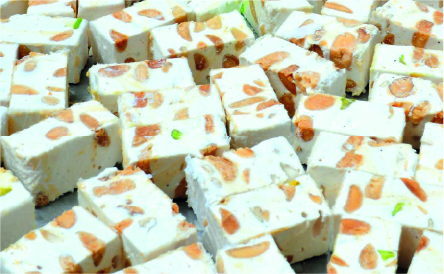
The terms "nougat" and Montélimar are inseparably intertwined since the end of the 17th century, when the first almonds were introduced in the region by Olivier de Serre, some years earlier.
The almonds, mixed with honey of Provence, have substituted the nut cake “nux gatum” or “nougo”. This transformation became and is the prerogative and specialty of Montélimar. The name of its creator is unknown to this day.
One also knows that the fact of having replaced the nut by the almond allows the confectioner of Montélimar to produce this nougat throughout the year. Because the nut quickly turned rancid and made production during the summer season impossible.
The most imaginative legend going back to the 17th century is that of Aunt Manon. Left without children of her own, this lady invited her nieces and nephews every week and offered them a dessert. They told her:” Aunty Manon, you are spoiling us” (« Tu nous gâtes”), When she died, Aunt Manon bequeathed the recipe « Tu nous gâtes” to her youngest niece under the condition that the dessert would be named “nougat” from thereon.
In 1701, Philippe d’Anjou, grandson of Louis XIV, heir to the Spanish throne, had passed through Montélimar with his brothers (Duke of Burgundy and of Berry) where he was presented with a hundredweight of white nougat by the consul of our town.
It then became customary to offer nougat to illustrious guests…
The A-road No. 7…
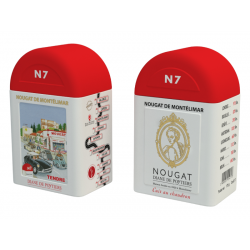
During the fifties, car traffic on the north-southern trunk road passed through the centre of Montélimar. The numerous cars advanced slowly only because they were permanently caught in traffic jams. This allowed the nougat producers installed along the road to sell their production directly to the vacationers heading back home. In 1968, the motorway A7 which connects Lyon with Marseille was inaugurated. As a result, the number of customers declined. Therefore, the nougat makers joined together in order to create conjoint retail outlets at the motorway service area of Montélimar.
A delicious and refined sweet…
The appellation “nougat” did not exist at the beginning. Only a few confectioners produced the sweet threat in form of “crack”. At that time, the nougat was presented in form of a block or type of bread which was cracked under great secrecy. It is a delicacy in Provence par excellence being part of the 13 desserts which are traditionally offered at Christmas Eve dinner. It is a fine sweet which is fabricated exclusively using a rigorous selection of precious ingredients. It is consumed either as dessert or as a sweet off the meals.
The tradition at Christmas…
Christmas has a tradition in Provence: the “thirteen desserts”. On Christmas Eve, the table is decorated with 3 white napkins, 3 candleholders with white candles (symbolising trinity and hope) and 3 bowls with wheat germs. Christmas Eve starts with a light meal prior to the midnight mess: generally, a soup. Mess is followed by a light dinner (fish, vegetables, pasta). Tradition has it that the 7 symbols of the 7 pains of the “Virgin Maria” are presented, followed by the famous “13 desserts”, symbol of Christ and his apostles.
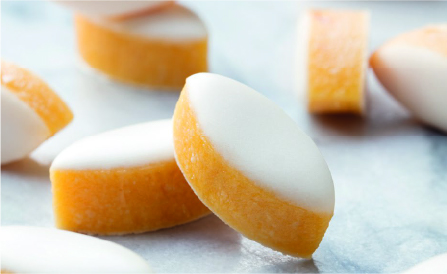
The 13 desserts consist of fresh fruits (apples, pears, fresh grapes, winter melon, sorbets, mandarins), of 4 “gorps” (almonds, dried figs, raisins, nuts), nougat (white and black) and of an oil pump (??). One may add, or replace, candied fruits, “calissons”, dates.
The Nougat of Montélimar…
The appellation Nougat of Montélimar is reserved to products containing at least 30% almonds or 28% almonds and 2% pistachios and 25% honey of various sorts…, including 2% lavender honey made in France. The nougat is not a guarantee of quality like a “AOC” or a geographical trademark, rather, it is linked to a specific recipe and a special know-how. The nougat exists under different tastes and numerous varieties, but the best known nougat is that of nougat of Montélimar.
|